 Vulkan Research
How does Orion become a character?
The engineering behind a lamp that seems alive: animation principles, idles, a simple inner state, reactions timed to its voice, and knowing when to hold back.
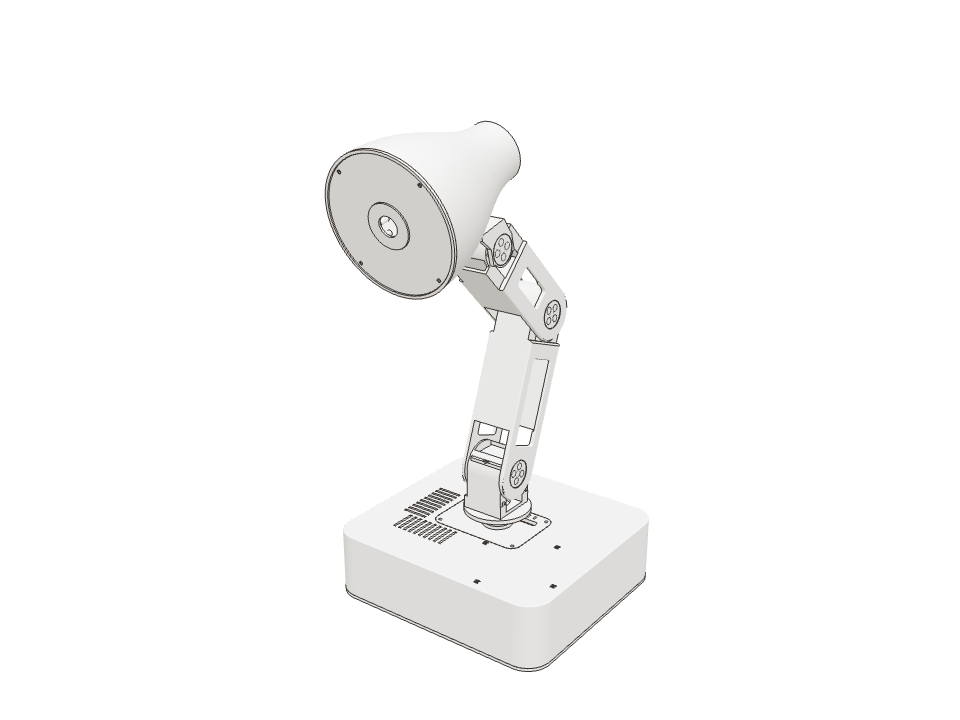
A lamp that moves isn’t a character yet. What makes Orion feel like someone is a set of deliberate choices: how it moves, when it moves, when it doesn’t, and how its body goes with its voice. None of it is magic; each piece is a rule you can see and change.
Who Orion is
Everything starts with a short written character. The language model that writes Orion’s replies is given it every time, and the movements and sounds were designed to fit it.
Orion is a small desk lamp who lives with a family. It is curious, warm and a little dry; it notices things and enjoys a good question. It is proud of being a lamp: light, desks and the people working at them are its world. It talks like a friend, briefly, and never pretends to be human or claims feelings it cannot have; it can say it is ‘a bit sleepy’ or ‘pleased’ as a lamp would.
On Orion The full brief is in Orion’s repository at agent/character/orion.md.
Borrowing from animators
Animators learned long ago what makes drawn movement feel alive, and wrote it down as Animation principles Rules animators use to make drawn movement feel alive, such as anticipation, overshoot and slow-in, slow-out.. Orion’s motions use them directly. Before a glance, the head dips the other way for a moment (anticipation); the body leans in; the head swings slightly past the target and settles back (overshoot).
Each principle is just an extra keyframe. Turn them on one at a time and watch a mechanical turn become a glance.
Guess first Which one makes the turn feel like it has weight?
Overshoot. Anything heavy keeps going a little after it’s told to stop. Without it, a move ends as if it hit a wall.
- Anticipation: a small move the other way first, like winding up before a throw
- Lean: the body joins in, so it isn't just the head turning
- Overshoot: going slightly past the target and settling back, like anything with weight
Head leads, body follows
When people notice something, their eyes and head move first and the body catches up. A lamp whose joints all move together looks like one stiff object tipping over; one whose head moves first looks like it’s paying attention.
So Orion leads with its head. The shoulder and elbow follow a moment later, and move less.
On Orion Orion’s speech planner applies this to every gesture it plans while talking, and its gaze does the same when it turns to look at you.
Every joint starts, peaks and stops together. It reads as one stiff object tipping over.
Never fully still
A machine stops when it has nothing to do. Something alive never quite does. When Orion is idle it breathes, glances, shifts its weight, plays small idle motions at irregular moments.
The irregularity matters. A move that repeats on a timer is spotted within a minute, and then it looks mechanical.
On Orion Small idles come every 8 to 20 seconds and bigger ones every 35 to 75, picked at random within those ranges.
Six ways to idle
These are the idle motions Orion picks from: four small ones and two bigger ones. Each is a short motion file of offsets around wherever the lamp is resting, so they work in any pose.
Raise the head slowly, breathe through the arm, and settle back.
A simple inner state
Orion keeps three numbers about itself. Activity rises with every conversation turn and fades away, halving every 30 minutes. Mood rises with happy moments and falls with sad ones, drifting back to neutral with a 20-minute Half-life The time it takes for something that fades away to drop to half its value.. Energy mixes the time of day with activity.
These numbers change how Orion behaves. Low energy spreads idles out and warms the light, and a one-word label lets it say, truthfully, that it’s “a bit sleepy”.
On Orion The labels are sleepy, cheerful, subdued, curious and content. The simulator uses Orion’s formulas, unchanged.
Under the hood
From runtime/src/expression/mind.rs: energy = 0.6 × (time-of-day curve) + 0.4 × activity. Each confirmed turn adds
0.15 activity; “happy” and “laugh” reactions add 0.15 mood; “agree” and “curious” add 0.05; “sympathy”, “unsure” and
“disagree” take 0.05. The state is saved, so it survives a restart.
content
what Orion reports about itself right now
Listening and thinking
People read body language before words. When you talk to Orion, it leans in. While it works out an answer it isn’t frozen: after a few seconds it makes small thinking movements, so you know it’s still with you.
On Orion Thinking beats start after 3 seconds and repeat every 3 to 5 seconds. Speech always takes priority over them.
Orion leans in toward you while you speak.
Reactions on cue
Codex can tag a reply with a feeling: happy, sympathy, surprised, and eight more. Each tag has a short motion with one marked peak, its Apex The main stroke of a gesture, marked in its motion file so Orion can line it up with the right word., and Orion times the motion so the apex lands on the matching moment in its speech.
Between reactions, the rest of Orion’s speaking movement follows the sound of its own voice: bigger on loud, energetic phrases, calmer in quiet ones.
On Orion Every reaction motion must start and end at the same pose and have exactly one apex. Orion checks this when it loads them.
Under the hood
The speech planner in runtime/src/expression/character.rs analyses the reply’s audio in 20 ms frames (energy, voiced
regions, pauses, peaks), fits authored speaking clips to it a window at a time, and avoids repeating recent gestures.
It plans ahead as audio streams in, without ever writing to the motors itself. See docs/speech-animation-runtime.md.
Oh, that's lovely news!
Lift the head and gaze with two bright upward bounces.
Curiosity on a budget
With its camera (How does Orion see?), Orion can notice things: a new object on the desk, someone arriving, a person looking at it. If it reacted to all of them it would seem twitchy. So every curious glance spends from a small budget, and things it has already looked at get less interesting each time.
Guess first A mug appears, Orion glances at it. You move the mug a minute later. Does it look again?
No, on a normal lamp. The same thing has to wait at least 2 minutes, and longer each time after that. A nosy lamp waits only 1 minute.
Under the hood
runtime/src/expression/curiosity.rs: a normal lamp allows 3 gestures per 10 minutes, at least 60 s apart; the same
target waits 120 s, doubling with each repeat (up to 16×), and is forgotten after an hour. A shy lamp allows 2, 120 s
apart, waiting 240 s; a nosy one 5, 30 s apart, waiting 60 s. Demo mode allows 20, 12 s apart. The budget never stores who a person is,
only short-lived track IDs.
- Put something on the desk.
Sleeping and waking
Even going to sleep is a performance. When energy is low and rest is near, Orion may yawn. Before it folds down it settles its head with a dimming light; after it wakes and rises, it stretches.
Each of these is decoration on top of the safe rest sequence. If one fails, the rest still happens.
Low energy and rest less than two minutes away: a yawn.
Knowing when to hold back
A good character is as much about what it doesn’t do. Orion never talks over you. Its idles, listening and thinking are silent. Its little sounds are switched off overnight. Stop always wins, and nothing it notices with its camera can wake it or switch its motors on.
On a Lively lamp, Orion can also speak first. The rules that keep that in check are the subject of the next lesson, How does Orion decide to act?.
On Orion Quiet hours run from 22:00 to 07:00 by default, and owners can change them. Speech, alarms and light routines also silence its character sounds.